Category: Uncategorised

  • The Left Teases a Path to Lending Its Support to the CCV Agreement

    On the eve of a crucial plenary vote, members of the Left parliamentary group sitting on the TRAN Committee, Martin de Montille, Jared Ong, and Eleonore Shalomita Hana, spoke candidly about their assessment of the provisional agreement on the clean corporate vehicles file and why, despite their reservations, they still see a path to lending it their full support.

    A Welcome First Step


    The three MEPs were broadly positive about the agreement’s existence. Before this proposal, there was simply no regulatory framework governing the transition of corporate vehicle fleets towards zero-emission vehicles. In that sense, the provisional agreement represents genuine progress. But for the Left, progress and sufficiency are two different things, and they have identified what they consider to be critical gaps that they intend to address. To that end, the group is tabling three amendments ahead of tomorrow’s vote. Amendments they argue are not radical additions, but necessary corrections.


    The “Made in EU” Problem


    Two of the three amendments concern the agreement’s treatment of the “Made in EU” concept. The provisional agreement leans on the definition provided by the Industrial Accelerator Act. This is a move the Left’s representatives argue is legally precarious, given that the Industrial Accelerator Act remains a proposal rather than adopted law. They contend that building binding obligations on the foundation of a legislative text that has yet to be enacted creates significant legal uncertainty.


    Their proposed fix is twofold. The first amendment would require that the final assembly of any qualifying vehicle take place within the European Union. The second would extend the reach of EU standards to all work going into manufacturing of the vehicle, regardless of where in the world that work is carried out. This would mean supply chains both inside and outside the EU would have to comply with EU norms on labour rights, environmental protection, health and safety, and state aid. Taken together, the two amendments aim to give the “Made in EU” dimension of the agreement a solid legal footing while ensuring it carries genuine social and environmental weight.


    Infrastructure Conditionality and a Conditional “Yes”


    The most consequential of the three amendments, however, concerns infrastructure conditionality, as set out under Article 3 of the provisional agreement. The Left argues that Article 3, in allowing member states to delay compliance on the basis of insufficient charging and refueling infrastructure, contains a loophole wide enough to significantly undermine the agreement’s ambitions.


    The Left wants the deadline of 2035 for this derogation brought forward to 2030. They view this as an essential change and it carries an explicit political offer. If this amendment is adopted, the Left have made clear they will vote in favour of the final agreement. The calculation behind that position is strategic as much as it is technical: they argue that a unanimous or near-unanimous backing for the package would send a message of political consensus, making the agreement considerably harder to unpick or revisit in the future and provide the clarity that the automotive industry so desperately desires. They have called on other parliamentary groups to take that argument seriously and accommodate the Left by supporting the amendment.

    However, they lament that their call has so far been met with a familiar obstacle. The group reports having been in contact with colleagues from other parties who, by and large, do not dispute the substance of the amendment. The problem is optics. Other groups are simply not comfortable with the appearance of aligning themselves with a party seen as extreme.


    A Strategy Shaped by Isolation and Solidarity


    That experience is not new to the Left, and it feeds directly into their broader assessment of the strategy they pursued throughout the negotiations. The reflection is pointed. They express clear disappointment at the behaviour of centrist groups, especially the S&D and Renew, who they see as having repeatedly voted down the Left’s proposals not because of any objection to their content, but simply to avoid the association with the party. What they find especially difficult to accept is the inconsistency that those same groups, they claim, have shown far less concern about the EPP’s case-by-case but frequent alignment with far-right parties.


    Their relationship with the Greens has been markedly different. The two groups continue to maintain close contact throughout the process and operate under the agreement that they would not publicly oppose one another. The Left’s MEPs underline that their differences are not ideological ruptures but a question of priorities. Where the Greens’ focus is primarily environmental, the Left’s lens is social. In practice, that meant the Left at times abstained on Green proposals they considered overly ambitious, rather than voting against them.


    Strange Bedfellows and a Message to the S&D


    One of the more striking admissions to emerge from the conversation is that the Left occasionally found themselves sharing common ground with far-right groups. This was especially true regarding the social dimensions of the regulation. They are quick to stress that it is a coincidence of position and not a convergence of politics. Nonetheless, it serves to sharpen their frustration with the S&D, whom they accuse of having drifted from the left-wing values that are supposed to define them. If parties at opposite ends of the political spectrum can identify the same social deficits in a piece of legislation, then a party that calls itself socialist ought to be able to do the same.

    As the Parliament prepares to vote, the Left’s message is simple: accommodate one amendment, and they will stand behind the agreement. Refuse, and a deal that could carry the weight of genuine consensus will pass with a political asterisk attached.

  • How Did the ENVI Committee Forget About the Environment?

    The following is a joint press release by the Greens and the Left.

    As trilogue negotiations on the regulation COM(995) conclude, the Greens/EFA and The Left acknowledge the efforts made by negotiating teams and colleagues across institutions to reach a compromise. While the final text contains some important advances, we express serious concerns that the agreement falls short of the EU’s climate ambition and risks weakening the credibility of the regulatory framework.

    We welcome, in particular, the strengthened social dimension of the regulation. The inclusion of provisions linked to the Social Climate Fund, alongside measures supporting worker protection, reskilling, and a just transition, represents a meaningful step toward ensuring that the transformation of the automotive sector is fair and inclusive. However, we regret that the allocation of revenues remains subject to a future Commission assessment rather than being firmly guaranteed in the regulation, leaving uncertainty about the scale and predictability of support.

    At the same time, the environmental integrity of the proposal has been significantly weakened during negotiations. The inclusion of low-emission vehicles through additional multipliers constitutes a major concern. This introduces further flexibility into the system,
    risks delaying the transition to fully zero-emission mobility, and sends contradictory signals to industry. It may penalise frontrunners that have already invested in full electrification
    while prolonging incentives for partially emitting technologies.

    Similarly, the expansion of flexibility mechanisms throughout the text undermines the overall effectiveness of the regulation. The investment-related reduction mechanism, even reduced from 15% to 12%, continues to weaken the deterrent effect of excess emissions premiums and risks slowing down necessary investments in zero-emission technologies.

    Overall, this compromise reflects a shift away from the original climate ambition of the Commission proposal toward increased reliance on flexibility mechanisms. While social fairness and industrial resilience are essential, they must not come at the expense of environmental integrity.

    The Greens/EFA and The Left call on all Members to reflect carefully on whether this compromise delivers on our shared climate and social responsibilities.

    The Left & The Greens
    ENVI Committee

  • On the Eve of the Plenary Vote, a Word of Realism From Industry

    The following is an opinion piece by Rahma Chikh, Head of EU and Governmental Affairs at European Automobile Manufacturers’ Association (ACEA).

    On Friday, the votes in plenary will define the trajectory of European automotive for the next decade. ACEA publishes this today, not to delay that vote, but to ensure it is cast with full awareness of what these texts demand and what remains unbuilt.

    From the opening committee discussions to the final trilogue rounds, ACEA worked continuously alongside the parliamentary majority driving these files, Renew Europe, S&D, the EPP and others groups as well as with different coalitions within the Council, to keep one question at the centre of the debate: does Europe’s automotive transition have the implementation realism it needs to succeed?

    That question was necessary because the provisional agreements reached on the revision of the CO2 standards for light-duty vehicles and on clean corporate vehicles are no longer
    simply climate legislation. They are industrial policies of strategic importance. They will shape investment decisions worth hundreds of billions of euros, determine the future geography of European manufacturing, and influence whether Europe remains an automotive production power or gradually becomes dependent on external industrial ecosystems.

    ACEA has participated constructively throughout this process. We contributed to consultations, technical dialogues and strategic exchanges with both Parliament and Council. At times, some of the automotive sector’s concerns were too quickly dismissed as resistance to transition. Yet the final trilogue discussions also demonstrated that a growing number of policymakers now recognise an essential reality: decarbonisation without industrial resilience is not a sustainable transition strategy.

    The European automotive sector directly and indirectly supports around 13 million jobs across the Union and accounts for approximately 7% of EU GDP. European manufacturers represented by ACEA have already committed more than €250 billion to electrification and battery technologies, an industry already undergoing one of the largest industrial transformations in its history while simultaneously facing unprecedented global competitive pressure.

    The challenge is no longer whether the transition will happen. The challenge is whether Europe can manage it without eroding its own industrial foundations.

    The agreements reached this week contain important improvements in that regard.

    Most notably, the clean corporate vehicles regulation abandons the idea of direct company-level mandates in favour of national targets for Member States. This distinction matters enormously. The operational conditions facing a leasing operator in the Netherlands are fundamentally different from those facing logistics companies in Romania, Bulgaria or parts of Southern Europe where charging infrastructure remains significantly underdeveloped.

    The compromise also recognises something ACEA and many fleet operators have consistently argued throughout negotiations: infrastructure is not secondary to electrification, it is its precondition. The regulation now allows Member States to request reductions of up to 10 percentage points in their national targets where charging infrastructure deployment significantly constrains uptake or where the transition creates serious employment impacts.

    That recognition is essential because corporate fleets are central to the success of Europe’s decarbonisation strategy. Around 60% of new passenger car registrations and nearly 90 % of new van registrations in the Union are corporate vehicles. Due to their rapid turnover cycles, those vehicles typically enter the second-hand market within three to five years, substantially increasing the future availability of affordable electric vehicles for European
    households. This second-hand market dimension is one of the strongest social arguments behind fleet electrification. But it only works if the market conditions enabling electrification actually exist.

    The revised CO2 standards also introduce long-awaited regulatory flexibilities. Multi-year compliance averaging between 2025- 2028 and 2030-2033 better reflects the realities of automotive production cycles and investment planning. Automotive manufacturing decisions are made years in advance and require long-term stability. Compliance systems based
    exclusively on annual snapshots create avoidable volatility, investment uncertainty and potentially disruptive market distortions.

    Equally important is the growing recognition that decarbonisation cannot be assessed solely through tailpipe emissions. The agreements introduce mechanisms linked to lifecycle emissions, sustainable renewable fuels and low-carbon steel. This reflects a broader industrial truth that Europe can no longer ignore: achieving climate neutrality depends not only on changing vehicles, but also on decarbonising the industrial ecosystems producing them. The agreement on low-carbon steel is particularly significant. The European steel sector produces approximately 146 million tonnes annually and represents around 8% of global steel output. Encouraging the use of low-carbon steel in vehicle manufacturing creates an industrial lead market capable of supporting both decarbonisation and European strategic autonomy.

    Yet despite these advances, the final compromises also expose unresolved contradictions at the heart of Europe’s industrial transition strategy.

    The first concerns global competitiveness. Chinese manufacturers accounted for roughly 3% of the European electric vehicle market in 2021. By 2025, that figure had approached 10%
    and continues to rise rapidly in key market segments. This expansion is not occurring under normal competitive conditions. Chinese manufacturers benefit from vertically integrated supply chains, large-scale state-backed industrial financing, subsidised battery ecosystems and domestic production scales European manufacturers cannot easily replicate. Multiple analyses estimate that Chinese EV production benefits from massive state support up to €10,000per vehicle in some segments. European manufacturers are therefore simultaneously expected to accelerate electrification, absorb major restructuring costs and
    compete against heavily subsidised external competitors.

    This is why the new “Made in the European Union” conditionality attached to public support after 2030 is politically understandable. Europe increasingly recognises that industrial dependency carries strategic risks. But the agreements still leave one fundamental issue unresolved: nobody yet knows what “Made in the European Union” will actually mean in practice. The criteria will only be defined later through delegated acts linked to the future Industrial Accelerator Act. For manufacturers, suppliers, leasing companies and fleet operators, this creates major uncertainty. Companies are now expected to prepare
    procurement strategies and industrial investments for 2029 and 2030 without knowing the criteria that will determine access to public support. The Commission must therefore publish the delegated acts defining “Made in the European Union” criteria before the end of 2027. Anything later risks creating investment paralysis precisely when Europe needs industrial acceleration.

    The second unresolved issue is infrastructure deployment. The revised CO2 standards now include a temporary safeguard mechanism reducing excess emissions premiums by 40% if
    more than 35% of Member States fail to meet their mandatory infrastructure deployment targets under AFIR. The existence of such a mechanism is politically revealing in itself. It reflects institutional recognition that manufacturers cannot be solely responsible for decarbonisation while infrastructure deployment remains uneven and insufficient. More than one million public charging points have now been deployed across the EU. Yet deployment remains deeply unequal geographically. Several Member States remain significantly behind AFIR trajectories, while freight corridors and peripheral regions continue to face major infrastructure gaps. The AFIR review scheduled before the end of 2026 must therefore include enforceable deployment mechanisms and stronger implementation oversight, not another cycle of reporting obligations without consequences.

    The social dimension of this transition must also be treated with greater seriousness. More than 1.7 million jobs in Europe’s automotive supply industry are directly exposed to the transformation of the powertrain ecosystem. The Saarlouis Body & Assembly closure last year eliminated 4,600 direct jobs in a city of 35,000 people with no comparable industrial anchor to absorb that workforce. In Mirafiori, the historic Stellantis complex in Turin that once employed 50,000 workers, production has been reduced to a fraction of its former capacity. These are not statistics. They are communities making irreversible choices about their economic futures on the basis of regulatory signals that must be coherent and credible. The agreements rightly refer to reskilling, labour-market transitions and just-transition safeguards. But Europe has often been far stronger at announcing transition frameworks than financing them adequately. The Industrial Accelerator Act must therefore include a dedicated automotive supply-chain chapter with concrete financing instruments supporting battery manufacturing, supplier adaptation, workforce reskilling and industrial conversion in the regions most exposed.

    The automotive industry understands the direction of travel. Climate neutrality remains the long-term objective and electrification will play a central role in achieving it. But Europe
    cannot regulate its transition faster than it can build the industrial, technological and infrastructure conditions necessary to sustain it. The agreements reached this week represent genuine movement toward a more pragmatic and industrially aware framework. It will depend on what happens next: delegated acts, infrastructure deployment, financing mechanisms, industrial support and implementation coherence.

    The real test therefore starts now.

  • Diverging Files, Fracturing Coalitions

    The second day of the intensive week of negotiations went down as a day of divergence between the two files at hand.

    Corporate Vehicles: The Finish Line in Sight

    On the corporate vehicle dossier, both the Council and the European Parliament’s TRAN Committee projected confidence that a deal was within reach. Both sides indicated that compromises had been reached on the vast majority of points, leaving only one article concerning social leasing standing between negotiators and a final agreement.

    CO2 Targets: A Different Story

    The atmosphere was markedly different for the CO2 Emission Standards file.

    COREPER Chair Simon Thomsen acknowledged that a final agreement remains likely as all sides recognise the need to inject flexibility into the existing framework. However, as ever, the devil is in the details. Discussions continue on how to best include these flexibilities with Thomsen listing the topics of life-cycle emissions and technology-neutrality, in particular regarding low-emission vehicles, as subjects that continue to occupy negotiators. The scale of incentives for small vehicles, as well as the nature of the support for SMEs also remain unresolved, with the Council noting that most SMEs in Europe’s automotive industry are not vehicle manufacturers but suppliers embedded in the broader value chain.

    Tensions Boil Over in ENVI

    The day’s biggest shocks, however, did not come from the Trilogues but from within the ENVI Committee itself.

    Despite repeated apologies from Committee Chair Edouard Huemer, who insisted that the delayed sharing of information with parties outside the centre coalition (EPP, S&D, Renew) had been an honest mistake, shadow rapporteurs lined up to denounce the handling of the negotiations. Their grievances went beyond the transparency lapse as several accused Rapporteur Maximiliem Jagiello of excessive deference to the Commission on key issues. The discontent culminated in a remarkable scene, as far-right groups, the Greens, and the Left rose from their seats in an unprecedented joint demonstration of protest.


    Knives Out

    What has followed, however, cuts deeper and threatens EPP’s unity at the precise moment the centre coalition needs it most.

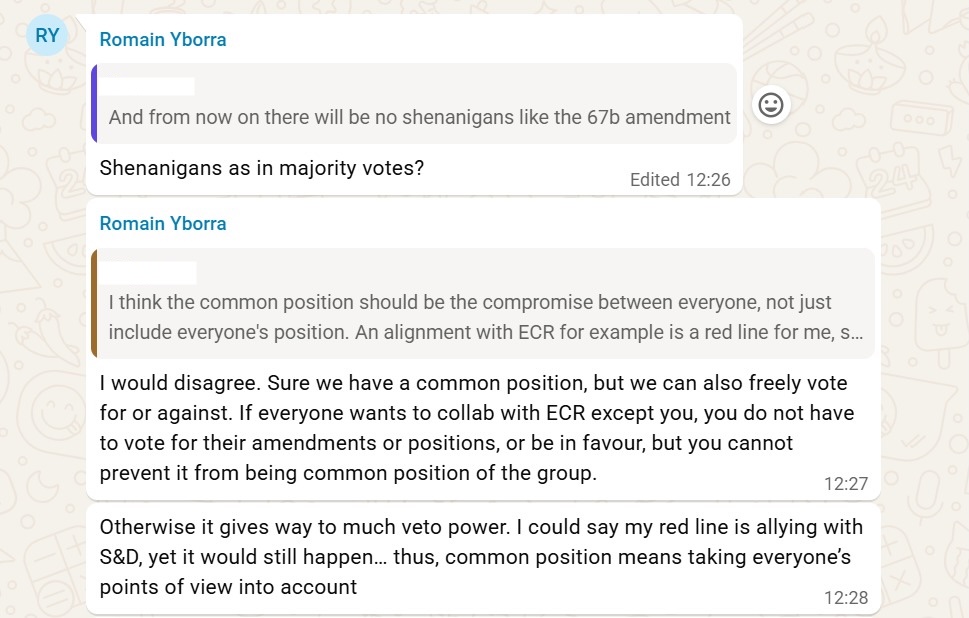
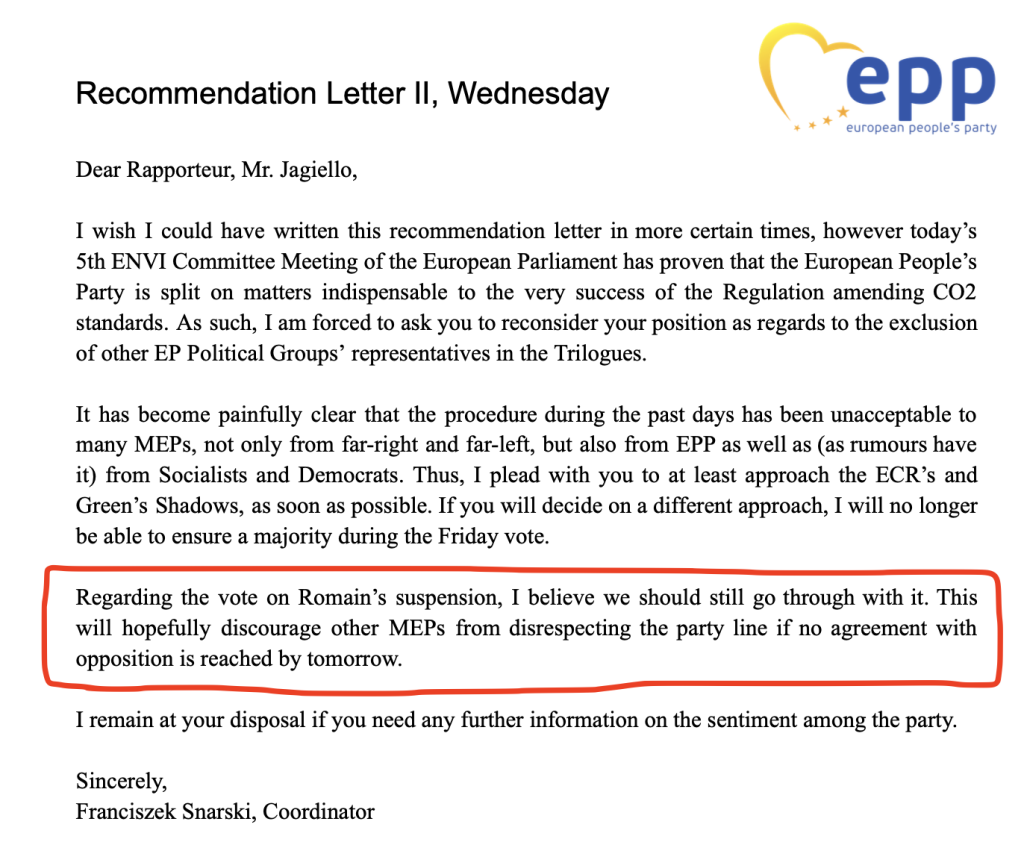
    EPP MEP Romain Yborra reportedly joined the cross-partisan protest, drawing scrutiny from his colleagues in the EPP. Anonymous sources had already raised concerns that Yborra has been willing to flirt with the far-right at the expense of internal party discipline. Those claims now appear substantiated by internal party communications obtained by Le Monde.


    While the absence of a cordon sanitaire against the far-right has long been a feature of this parliament, Yborra’s apparent equation of the S&D with the ECR raises difficult questions. Some from left wing parties have privately complained of needing to “remind” S&D and Renew of their own positions. These concerns are more immediate than ever, as the centre coalition risks drifting rightward, pulled by parts of the EPP with few reservations about working with the far-right. This phenomenon which was first observed in the TRAN Committee appears to be rearing its head in ENVI as well.

    That is unless the EPP takes measures to quash Yborra’s insubordination. A second anonymous EPP source has provided Le Monde with details of such a proposed move for Wednesday’s session. The document below speaks for itself.


    Whether that vote materialises and what its outcome might be remains to be seen. However, one thing is clear. A clerical error in sharing information has set off a chain of events that has laid bare the long simmering fractures within the EPP. Those fractures must now be sealed at speed.

    For the S&D, these revelations pose an uncomfortable question: what does continued partnership with EPP mean if it cannot keep its far-right sympathising wing in check?

    With two days of Trilogues remaining the CO2 file is far from resolved, time is running out, and the centre may be less solid than it looks.

  • Test 2

    This is a second test to see how multiple pieces appear on the page.