
Written by Contexte
18 May 2026
As European co-legislators lock themselves in to decide the future of the automotive industry, tensions are spilling far beyond the meeting rooms in Brussels. While the phase-out of internal combustion engines by 2035 now appears largely settled, the current battle is focused on the architecture of flexibilities granted to manufacturers and, above all, on the social dimension of this regulation. On the ground, concern has turned into outright anger over what is perceived as a complete abandonment of workers.
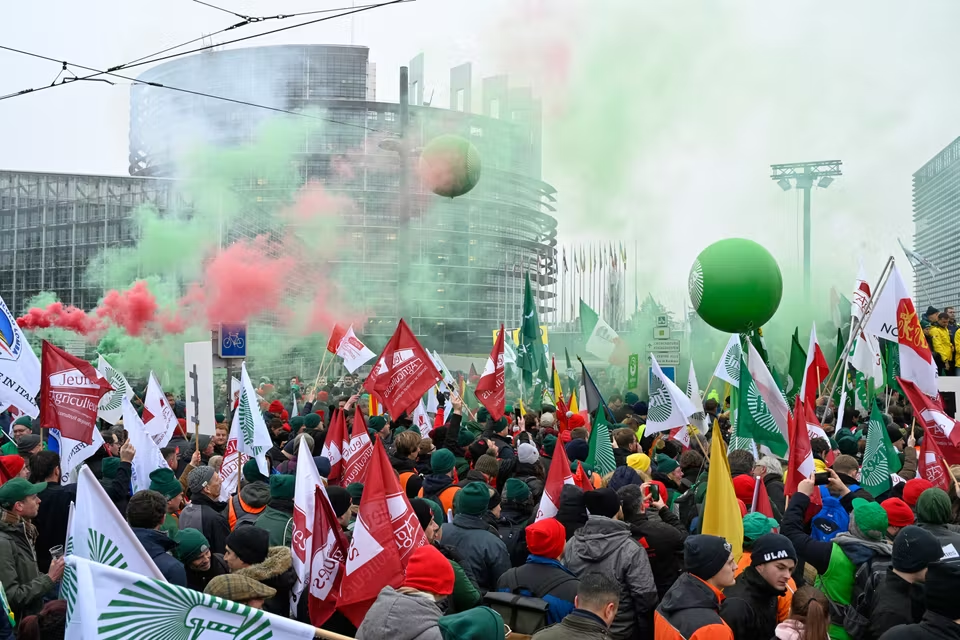
Illustration: On European assembly lines, anxiety and anger are growing among automotive workers, whose future and jobs are directly dependent on concessions negotiated behind closed doors during the Brussels trilogues. Photo taken by our team on site.
The clash of visions: “industrial comfort” versus job protection
The core of the conflict lies in the gap between the European Parliament and the Council of the European Union (EU). The Parliament’s mandate, adopted by the ENVI committee (Committee on the Environment, Public Health and Food Safety), sought to rebalance the advantages granted to manufacturers by attaching strict social obligations to them. It notably included requiring companies to notify governments before any restructuring and to adopt “workforce transition plans,” while allocating 55% of fine revenues to the Social Climate Fund.
But this approach runs up against the Council’s position. Driven by the so-called “Pragmatic Coalition” (Hungary, Poland, Czechia, Slovakia), the Member States’ approach resembles more a package of “industrial comfort,” multiplying flexibilities (super-credits, lower fines, extended compliance windows) without requiring social conditions in return. Worse still, recent trilogue negotiations saw the sudden removal of derogation mechanisms intended to protect industries in the most exposed countries, raising fears of mass unemployment and deep economic distress.
Ground-level fury: “A shameless mass layoff plan”
For representatives of automotive workers, the conclusion is clear-cut: European institutions appear ready to sacrifice labour in the name of institutional compromise and competitiveness against China.
Marek Kowalski, Secretary General of the European Automotive Workers Alliance, is sharply critical of the Council’s refusal to adopt social safeguards:
“The Council is handing out super-credits to manufacturers, but rejecting our safety net. They are turning the ecological transition into a shameless mass layoff plan funded by public money!”
In factories across Eastern Europe, the removal of derogations has landed like a shockwave. Elena Rostova, a worker on a battery assembly line in Slovakia, describes a widespread sense of anxiety on production floors:
“Automotive is our only industry. If we are forced to move forward blindly, our factories will close tomorrow morning. We want to save the climate, but who will save our families?”
A warning of an imminent social fracture
Even within the European Parliament, some observers are watching the dismantling of the ENVI committee mandate with growing concern. Isabella Rossi warns of the cynicism of the ongoing negotiations:
“Removing these protections to satisfy manufacturers’ margins lays the groundwork for the most severe social crisis since the 1980s.”
While the Commission and the Council clash over discretionary funding shares and state sovereignty, workers insist that without employment protection, the ecological transition risks collapsing against the reality of its social consequences.