
Written by Contexte
18 May 2026.
The trilogue negotiations on the regulation of the European automotive sector have left deep fractures within the Council of the European Union (EU). Far from the image of an institutional consensus, countries from the so-called “pragmatic coalition” are denouncing a biased process in which the Council allegedly capitulated to the demands of the European Parliament and the European Commission (EU). This is what emerges from the testimonies of two Council representatives: Sara Zehnder, representing Slovakia, and Luka Nedeljković, representing Bulgaria.
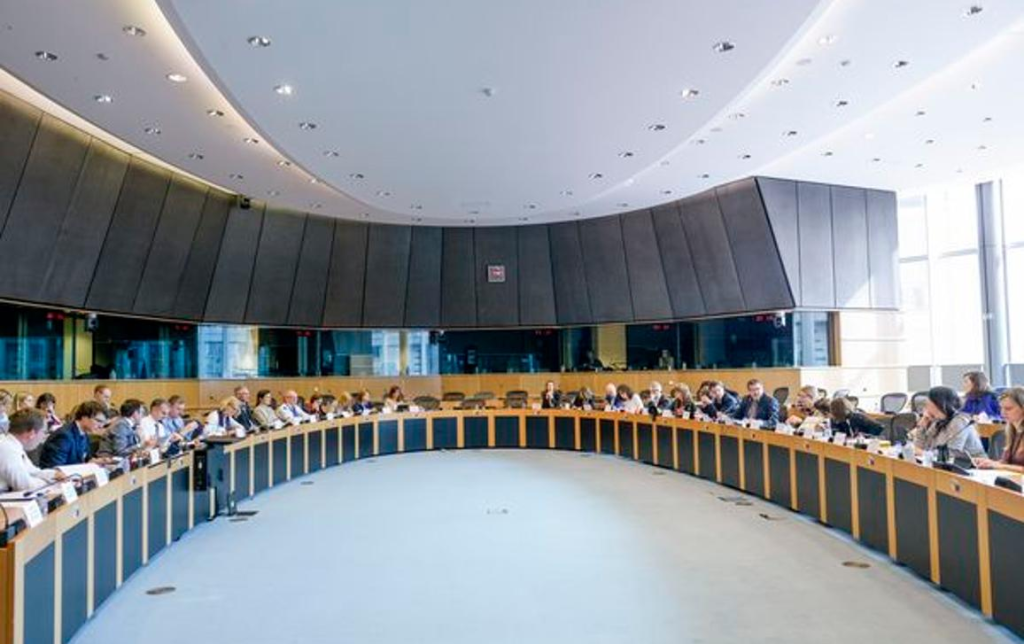
Illustration: Far from the apparent consensus, this interinstitutional negotiation session crystallises the deep European fractures in the face of the ecological transition requirements and the threats of a blockade by the countries of the “pragmatic coalition”. Source: europarl.europa.eu/
Internal compromises swept aside
For these representatives, the day of trilogue negotiations did not resemble a genuine negotiation, but rather a sequence of unilateral concessions made by the Council Presidency. They argue that internal compromises, laboriously negotiated among the 27 Member States (including countries from the “Green coalition” such as Denmark), were simply removed from the final positioning during the trilogue phase.
For Sara Zehnder:
“It was supposed to be a day of negotiations to find an agreement together, and in reality what has happened is that the Council just gave a lot of concessions. And this was not a negotiation process; it was just them accepting what the Parliament and the Commission said.”
“I think that the interest of the European Commission is just to move towards a green transition. but they just want to do it without considering the context of each country. They are completely overlooking this.”
The European Commission is particularly targeted by these criticisms. According to them, although the ecological transition is a shared objective, the Commission is accused of imposing it in a uniform way without sufficiently taking into account the specific realities and economic contexts of each Member State.
The removal of derogations: a blow to employment and cold climates
The first major breaking point concerns the total erasure of the derogation mechanisms that had been planned by the Council of the European Union (EU). These derogations were intended to grant additional time and reduced targets to certain countries, in order to protect their heavily exposed automotive industries and avoid massive unemployment and economic disruption linked to an overly abrupt transition.
For Sara Zehnder:
“All of the derogation mechanisms that we had discussed were removed. And this is not right… this is crazy. This is crazy!”
These exemptions also concerned specific geographical and meteorological conditions. Baltic countries with cold climates (Estonia, Latvia, Lithuania) as well as island Member States were expected to benefit from them in order to address their implementation challenges. Their sudden removal during the trilogue process triggered strong concern among delegations from Eastern Europe and smaller states.
Financial support: a question of “state sovereignty”
The other red line crossed during these closed-door negotiations concerns Article 6, relating to state financial support (subsidies). The Council had agreed on a clear distribution: 75% of public financial aid was to be directed towards zero- and low-emission vehicles, leaving a 25% margin at the full discretion of Member States.
The European Commission strongly opposed this flexibility, demanding that 100% of the funds be allocated to clean vehicles, a position that was endorsed in the trilogue. For Slovakia and Bulgaria, this is seen as a direct affront:
“It’s our money; this is against state sovereignty.”
This 25% discretionary margin is considered essential to support the entire automotive value chain in transition, a sector that represents a significant share of the economy in these countries (over 11% of GDP in Bulgaria).
The ultimatum: the threat of a total blockage
Faced with what they describe as a “crazy” situation, these countries refuse to be sidelined. Arguing that Member States are being asked to meet ambitious targets without sufficient financial tools or time, Bulgaria and Slovakia are preparing for a confrontation.
Claiming to have a blocking minority with the support of major players such as Poland, Spain, and Germany, they issue a clear warning to Brussels. If they do not obtain the reinstatement of at least one of their two key demands — either the return of the derogation mechanisms or the restoration of their 25% margin of discretionary subsidies — they promise to block the regulation outright.
“They want every country to reach the targets but without anything to help them… no financial support, no discretion… If we don’t have the derogations, if we don’t have 25%, we will block the text.”