
Written by Contexte
18 May 2026
Facing Members of the European Parliament, they are the voice of the European capitals. The Council of the European Union, which represents the governments of the Member States, is the indispensable co-legislator in the ordinary legislative procedure. As trilogue negotiations intensify this week, Council representatives hold immense power to steer, block, or derail the talks. A deep dive into the diplomatic and political machinery of the Member States.
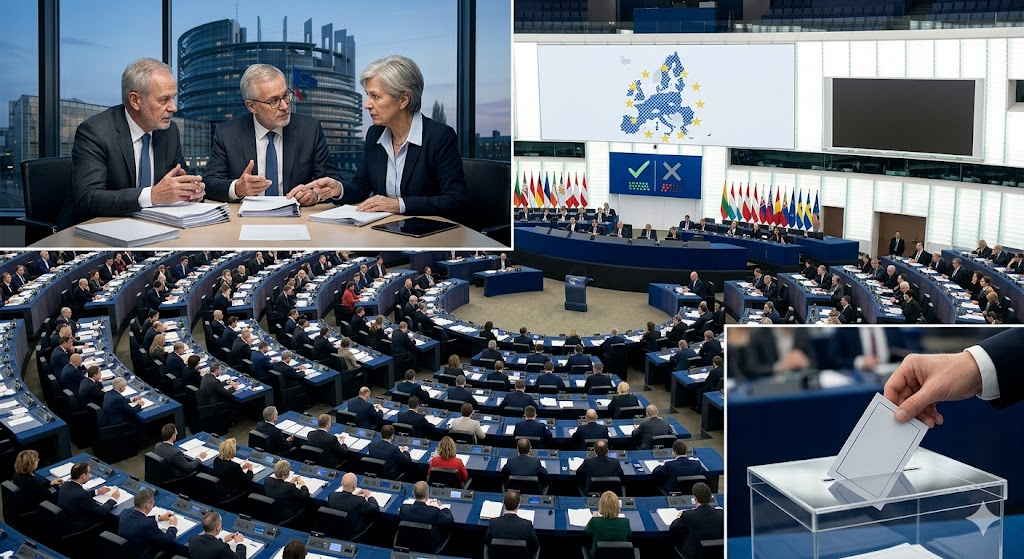
Illustration: A deep dive into the heart of the Member States’ diplomatic machine, somewhere between technical meetings and blocking minority calculations. Generated by AI.
Any resemblance to the MEPs from yesterday’s article is fully intentional: our virtual extras simply put on their national diplomat costumes just long enough to switch paragraphs.
Under the ordinary legislative procedure, no law can be adopted without the equal agreement of both the European Parliament and the Council. While the Parliament is highly visible in the media, the Council is an equally formidable machine operating through a three-tier structure: technical working groups, the Committee of Permanent Representatives (COREPER), and finally the Council of Ministers itself. It is the Member State holding the rotating Council presidency (for six months) that chairs these meetings and leads negotiations with Members of the European Parliament during trilogues.
But the presidency does not have a free hand. This section explores the various levers Council members (the Member States) can activate to block or amend a text.
The unforgiving COREPER filter
The presidency team negotiating in trilogues operates under a strict mandate, often defined by a publicly adopted “general approach.” After each trilogue session, Council negotiators must report back to COREPER or the relevant working group. Any compromise reached in trilogue remains strictly provisional. If a majority of ambassadors sitting in COREPER considers that the presidency has made too many concessions to Parliament, they can refuse to endorse the agreement. In practice, an agreement only becomes official once the COREPER chair sends a formal confirmation letter of the provisional deal to the chair of the parliamentary committee.
The threat of a blocking minority in the ministerial vote
If the text passes COREPER, it must then face the formal vote of ministers, the only level where official votes are cast. The Council most often decides by qualified majority voting. This means an agreement must gather at least 55% of Member States (at least 15 countries) representing at least 65% of the EU population. Governments opposing a text do not need to be in the majority to block it; they only need to coordinate to form a “blocking minority” preventing the double political and demographic threshold from being reached.
The absolute veto weapon (with the Commission’s help)
Member States’ blocking power is significantly amplified in a specific scenario: when the European Commission issues a negative opinion on proposed amendments (for example, if it considers that Parliament and Council have distorted its original proposal). In such cases, the treaties require unanimity in the Council to adopt the amendment. A single veto from any of the 27 Member States is therefore enough to block adoption.
The power move: imposing a position and triggering a second reading
What happens if negotiations fail completely? If the Council is unable to approve the European Parliament’s position and amendments in first reading, it does not simply abandon the process. It formally adopts its own first-reading position and transmits it to Parliament. This move ends any hope of a rapid agreement and triggers a difficult second reading, forcing both institutions into strict deadlines of three to four months to reach a resolution.
In conclusion, while the rotating presidency leads the choreography inside the trilogue room, national capitals retain the handbrake through COREPER oversight and qualified majority rules. Pressure remains at its peak until the very end.