
Written by Contexte
18 May 2026
Interinstitutional negotiations (trilogues) on the decarbonization of the European automotive sector are opening in a climate of high tension. During a final press conference before locking themselves in to negotiate, representatives of the European Commission, the Council, and the Parliament laid their cards on the table, illustrating the wide gap between maintaining climate ambitions and protecting a threatened industry.
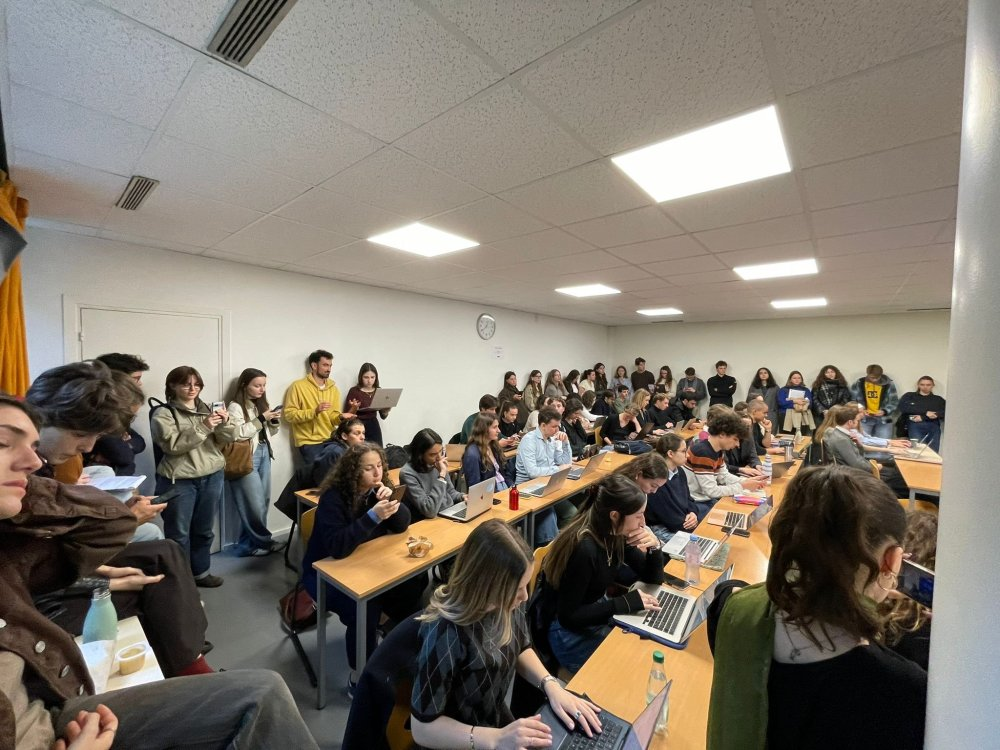
Illustration 1: The fewer the seats, the more ideas there are. Confined in this small room, the actors had to face the press’s major questions and confront their positions. A forced physical proximity which, at the very least, has the merit of bringing viewpoints closer together.
The Commission stays the course on 2035
According to Konstantinos Gkoumas, Head of Cabinet, DG CLIMA:
The red line for the Commission is that the final text must preserve the credibility of the 2035 transition and the overall climate ambition. What we can discuss are the ways to make the transition workable, such as flexibility, timing, support measures, and implementation details — but not the objectives. So the direction remains clear for us: Europe has to keep moving forward towards zero-emission mobility.

Illustration 2: Aliénor Marchand (left) and Konstantinos Gkoumas (right), representatives of the European Commission, illustrating with big smiles the art of dodging the issue, whether by skillfully evading the technicalities of biofuels or conveniently relegating the definition of “Made in Europe” to another Directorate-General.
For the European Commission, the absolute red line is preserving the credibility of the 2035 transition and the overall climate ambition toward zero-emission mobility. While it says it is open to negotiating the means to make this transition “workable” (flexibilities, timing, support measures), the final objectives cannot be called into question. Challenged by environmentalists on its choice to initially include low-emission vehicles (such as hybrids) and biofuels, the Commission defended a “progressive” approach designed to align coherently with the recent Industrial Accelerator Act. In terms of sovereignty, the Commission clearly stated that it did not wish to define the “Made in EU” criteria in this specific text, preferring to leave that responsibility to other directorates and regulations.
The Council united around “pragmatism” and competitiveness
On the Member States’ side, priority is given to protecting industry and employment. Several countries such as Italy, Slovenia, and Bulgaria, as well as Austria and Germany, which are close but not officially in the “pragmatic” coalition, are campaigning to maintain technological neutrality and strong flexibilities. This group fiercely defends maintaining credits for renewable fuels (at 4%) and for low-carbon steel (at 6%), as well as the use of super credits to support manufacturers.
Croatia, Czechia, Slovakia, and Hungary have joined these demands, but they have drawn a categorical red line: the total refusal of the social requirements added by the European Parliament. Worried about their competitiveness in the face of the massive arrival of Chinese electric vehicles, these countries strongly criticize the bureaucracy these measures would generate. Their spokesperson summarized this position with a hard-hitting statement:
“We are in the European Union, not the Soviet Union. We already do have labour rights.”
They nevertheless say they are open to discussing super credits, provided that these serve to reallocate financial resources towards electrification without increasing the burden on Member States.
Renew Europe: “Made in Europe” in the law and life-cycle assessment
Strengthened by its centrist alliance with the S&D (Social Democrats) and the EPP (European People’s Party), the Renew Europe group approaches the trilogues with a clear mandate. Their main political battle is in direct opposition to the Commission: Renew demands that the definition of “Made in Europe” (thresholds for Union-produced components, requirements for batteries and software systems) be written directly and democratically into the legal text, and not relegated to future delegated acts. “Industrial sovereignty means controlling the technology, not just assembling it with a screwdriver,” they stated.
Furthermore, Renew fiercely defends its flagship initiative: life-cycle assessment (LCA). This methodology, which includes labeling obligations and super credits for manufacturers greening their supply chains, must not alter the final objective of reducing tailpipe emissions. The group supports flexibilities, such as a 5% gap for sustainable fuels and 5% for low-carbon steel, while warning that it will oppose “any further dilution of climate conditions” that would threaten the green transition. Faced with the EPP (European People’s Party) demanding a simplification of standards, Renew assures that the LCA was designed not to impose excessive burdens.
The Greens warn of the risk of a “car museum”
Isolated in the face of these concessions, the Greens (TRAN committee) are alarmed by the trajectory taken by the negotiations. They vigorously denounce the progressive inclusion of plug-in hybrids, recalling that their actual emissions are much higher than officially stated, as well as biofuels, which they accuse of promoting deforestation.
According to them, the Commission’s initial proposal was already a major compromise, and the multiple exceptions introduced by the European Parliament dangerously weaken the European Union’s (EU) climate ambition. They warn that while international competitors are investing massively in 100% zero-emission technologies, multiplying thermal flexibilities risks turning Europe into a veritable “car museum”.