
Written by Contexte
2 May 2026
Amid International Workers’ Day protests across cities like Paris and Brussels, workers and small business owners warn that the European Green Deal risks causing serious economic and social disruption if infrastructure and financial support do not precede its implementation.
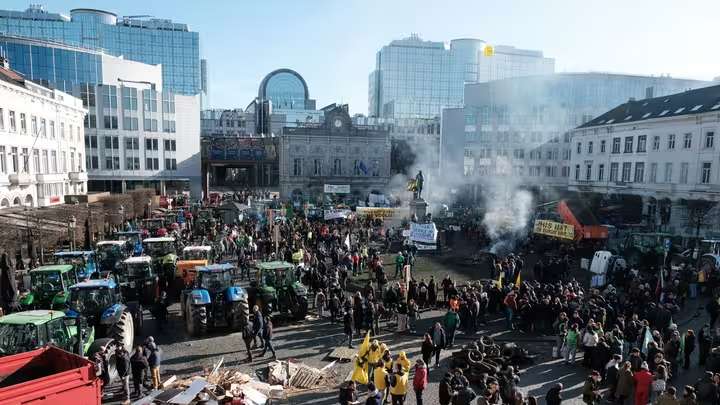
Illustration 1: Photo taken by our colleagues at France 2 in Brussels on May 1, 2026. As a reminder, after several weeks of protests across different European countries, farmers and their tractors had already demonstrated in Brussels on February 1, 2024, in a march organized by numerous European workers’ unions.
During the week of International Workers’ Day, continuing the demonstrations that simultaneously took place in Paris, Brussels, Strasbourg, and Luxembourg, a major protest was held in Paris. According to French labor unions, nearly 50,000 people took to the streets of the capital. Within the union marches, some workers and small business leaders were not only expressing traditional wage demands, but also voicing concerns about the European Green Deal.
To provide a clearer understanding of this debate, the Contexte team went out to meet those who would be most directly affected by such reforms.
The Contexte team spoke with Peter Smith, a Slovak small business owner specializing in heating installation, and Mathieu Lecomte, a German worker in the automotive industry visiting Paris. Both used May 1st as an opportunity to address policymakers and highlight the major challenges they face in relation to the ecological transition.
The challenge of a rural small business owner: Peter Smith’s logistical dead end
Peter runs a small family-owned heating installation company in rural Slovakia, which currently employs twelve people. For this small business owner, his vans are not a luxury but genuine mobile workshops, loaded with heavy equipment essential for working in farms and isolated villages.
For his SME, the electrification of vehicles raises overwhelming practical and financial challenges:
“Purchasing electric utility vehicles represents far too heavy an investment for a small structure, even on the second-hand market, and rural areas suffer from a critical lack of charging stations; the downtime required for recharging translates directly into a loss of revenue.”
Emphasizing that small businesses do not have the same resources as large corporations, Peter is calling on policymakers to first provide the necessary infrastructure before imposing unsuitable regulations, so as not to force craftsmen to choose between the ecological transition and the survival of their business.
The automotive industry facing a social wall: the anxiety of Mathieu Lecomte, a German worker
For his part, Mathieu illustrates the pressure weighing on the other end of the chain. A worker in a German factory producing automotive components, he speaks on behalf of his colleagues and his local union. While he supports European environmental objectives, he warns of the social disaster that an overly abrupt transition could trigger.
“We’re not against the transition, but without investment and time to adapt, it’s the workers who will end up paying the price.”
In his factory, the situation is alarming: due to a lack of capital and technical expertise to rapidly convert production lines to 100% electric, half of the site’s jobs are now under threat in an effort to comply with upcoming European standards. For Mathieu and his colleagues, it is industrial workers who are likely to pay the highest price for decisions disconnected from realities on the ground.
The infrastructure ultimatum for a just transition
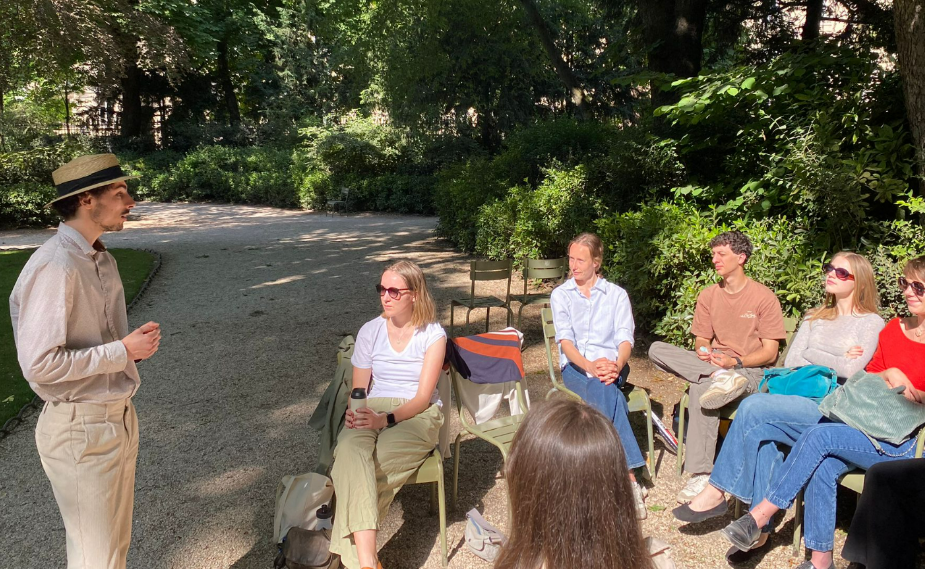
Illustration 2: Anatole Rawas, stakeholder at Leaseurope, addressing far-right Members of the European Parliament (MEPs) during the march on the evolution of democratic debate.
For the workers present at the march organized by the European far right, the dilemma is clear: the success of the European Green Deal will not be measured by the strictness of its standards, but by its ability to be adopted by intermediate economic actors. The transition can only be described as “just” if it follows a logical sequence, summed up by the ultimatum from those on the ground: “First give us the financial means and the infrastructure, and only then will we be able to adapt.”
For entrepreneurs like Peter or German equipment suppliers to become drivers of the transition rather than its victims, the legislative framework must necessarily take into account the realities of SME and supplier life cycles. The balance between climate urgency and operational viability remains the most sensitive political challenge of the current term—an essential condition to prevent the Green Deal from turning into a driver of deindustrialization and social fragmentation.